
SPECIAL OFFER: Order 1 of 100 revoloud for free now!
revoloud Card Game
Experience firsthand, in a fun and hands-on way, how revoloud makes revoloud perception of loudness visible
A loudness map, three possible categories—and a solution that’s often surprising.
On this page, you can classify a real-life example from the revoloud yourself, view the answer, and—while the promotion is active— order one of the limited-edition revoloud for free from your local music store.
Unfitted, First-Fit, or
Your Own Hearing Aids?
That is the question!
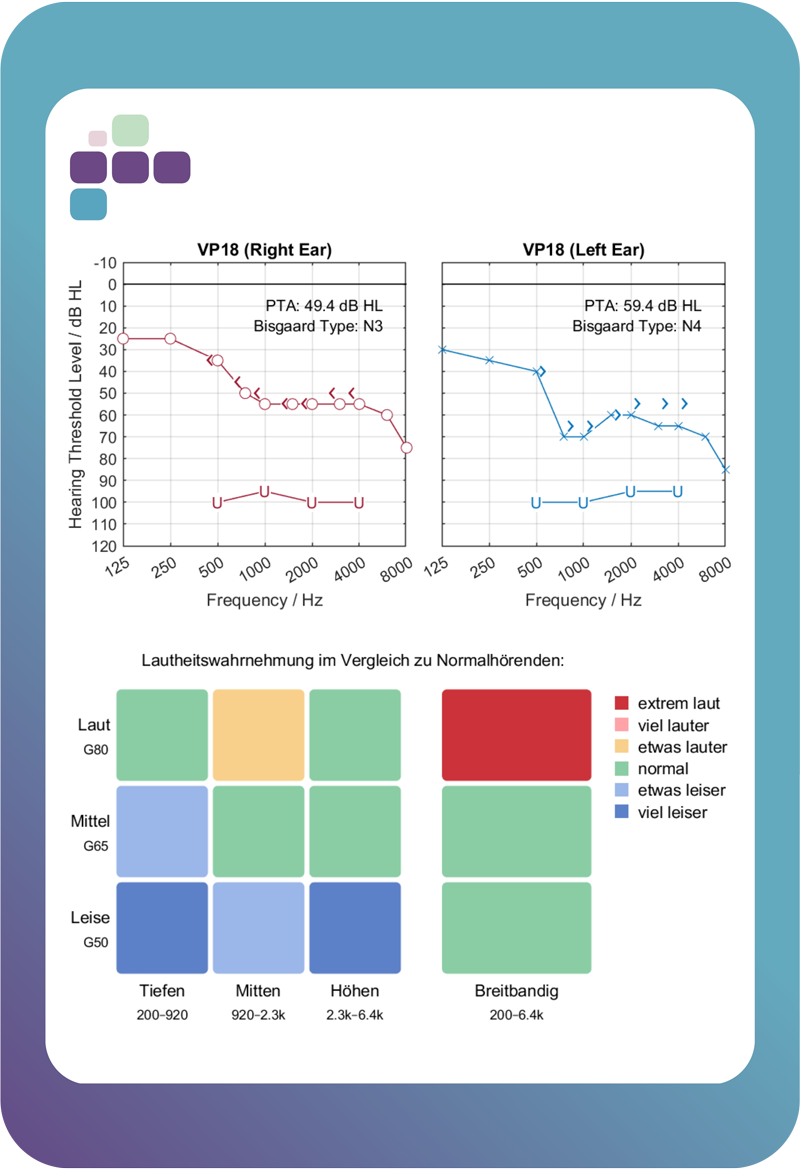
Under what conditions was the loudness map shown here recorded?
Not sure what to do?
Click here for the answer
Solution: First-Fit
The playing card shown here from the revoloud displays the audiogram and the revoloud with hearing aids set according to the manufacturer’s first-fit settings. The loudness chart uses color coding to show the individual’s perception of loudness compared to that of people with normal hearing. This is indicated by revoloud .
The colors indicate that the amplification setting in the hearing aids is not optimal.
At low input levels (G50), the loudness map shows undergain. The person perceives natural sounds in all three frequency ranges as slightly quieter (light blue) and even much quieter (dark blue) than people with normal hearing. Therefore, the amplification in the hearing aids should be increased for G50. This typically improves speech understanding, especially for soft speech.
On the other hand, the loudness map shows over-amplification for loud input levels (G80) for mid-frequency and broadband signals. At mid-frequencies, the person perceives the signals as slightly louder (yellow) than those with normal hearing. Broadband signals are even perceived as extremely loud (dark red) . To improve loudness perception, the gain for mid-frequencies should be reduced. If increased loudness perception for broadband signals persists even after reducing the mid-frequencies, the gain for G80 should be reduced for low, mid, and high frequencies. Reducing the gain for G80 usually leads to greater acceptance of the hearing aids, even in loud environments.
It becomes clear:
Without measuring and visualizing loudness perception, it is difficult to determine whether a hearing aid setting is truly balanced.
This is precisely why revoloud a unique method for assessing loudness perception (with and without hearing aids), which has become indispensable .
✨SPECIAL OFFER
Want to see more cases?
Get 1 of 100 revoloud card decks for free now! 🎁
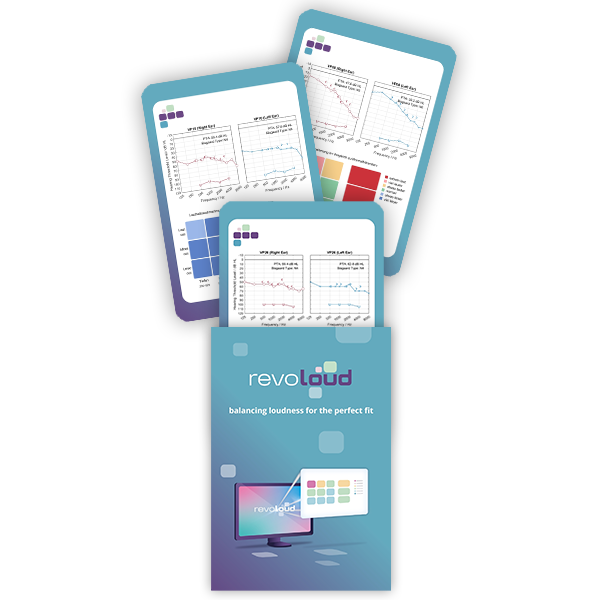
Solve more cases, explore the revoloud, and gain clarity in the world of loudness perception.
Order the revoloud for free using the form below.
While supplies last!
Please fill out the form completely.
We will send you the revoloud as soon as possible.
Game Instructions
All the info on the revoloud card game
We are especially excited to introduce you to revoloud in a fun and engaging way revoloud the revoloud. Each card in the deck features audiograms and revoloud based on real-world measurements.
The goal of the game is to classify the perceived loudness shown into one of the following three categories:
- Unattended
- First-Fit
- Custom hearing aids
The revoloud is easy to incorporate into your daily routine—whether in a team setting, during training sessions, or just for a quick break. Placed on display in a waiting area, this deck of cards also serves as an eye-catcher for your customers.

Here's how to play:
1. Preparation
Place the loudness and category cards on the table in front of you.
2. Sorting
Each player selects a loudness card and assigns it to one of the three categories based on their own assessment. They then briefly explain their decision. This process is repeated in turn until all loudness cards have been assigned to their respective categories.
3. Check
After all the cards have been sorted, the players check the matching together and then count the number of correctly sorted loudness cards. The solution is on the back of the loudness cards: Unfitted measurement, First-Fit manufacturer & own hearing aids


Our support times:
Mondays to Thursdays:
08:00-17:30
Fridays:
08:00-13:00